Friday, 29 June 2012

Notes from Eve Abbey ~ June 2012


Publishers are also responding to the demand for cheaper books and there are an increasing number of announcements about new ranges such as the Penguin Black Classics and Popular Penguins ($9.95), the Vintage Classics ($12.95) and the latest collection to appear, Text Classics for Australian authors ($12.95).

Abbey’s stock ALL of these titles all the time. Stocking the backlist titles is one of Abbey’s virtues. If one is temporarily out of stock, we’ll do a special order for you. And publishers are responding to the cry for cheaper books. Many are now reissuing good titles in new formats at much lower prices. There would be more than a hundred good books in these new series which you can enjoy for less than $20.

Amongst the many exhibitions at the National Museum of Australia in Canberra there is an excellent display from the American Museum of Natural History in New York. It is called Travelling the Silk Road and is on until 29 July. This is about the legendary trading route from China to the Mediterranean, through desert lands and exotic places such as Tashkent and Samarkand. I once landed in an aeroplane at Samarkand. It was very disappointing – but then most airports are! The journey along this route enabled Chinese inventions such as paper, gunpowder and silk to become available in Europe. I looked at Journeys on the Silk Road by two Sydney journalists, Joyce Morgan and Conrad Walters ($34.99 Pb 323pp incl. index), but this turned out to be rather specific – about the discovery in the Taklamakan Desert of a buried Buddhist library by Aurel Stein in 1901. More specifically it is about the discovery and journey of the oldest printed book – the Diamond Sutra – and its journey to England. A journey not yet finished I think. I also want to remind you about another book that talks about the early Chinese discoveries which came to the West, and that is Simon Winchester’s marvellous book Bomb, Book and Compass: Joseph Needham & the Great Secrets of China ($26.95 Pb).

I then looked at Inside Central Asia by Dilip Hiro ($32.99 Pb 480pp incl. index). This is subtitled A Political and Cultural History of Uzbekistan, Turkmenistan, Kazakhstan, Kyrgyzstan, Tajikistan, Turkey and Iran. It was published in 2009 and has an epilogue added in 2011. Dilip Hiro is the ultimate expert on this area (together with India and the Middle East). So although it is not quite the old Silk Road, it is your chance to make sense of all those strangely named places which are now becoming important to the West.

I’ve had a lovely time reading the latest Donna Leon which is called Beastly Things ($29.95 Pb). You can also get this on CD ($35). Commissario Brunetti now has his very own computer although Signorina Elletra is the one who works wonders. This time the setting is in the abattoirs outside Venice and I notice Donna Leon is becoming more ardent about vegetarianism – with Chiara her spokesperson. And Inspector Vianello is becoming more important. This is number 21 in the series and you can find the earlier ones in our Crime section.

I have (sort of) read and enjoyed Promise by Tony Cavanaugh ($29.99 Pb 327pp), a well-known scriptwriter. Graeme Blundell, whose opinion I respect, calls it “chilling and memorable: top-notch Aussie noir, definitely not for the faint-hearted”. This explains my “sort of” remark because I did indeed need to skip some parts. Nonetheless, braver readers than I will think this is terrific. A tense and thrilling story.

I must enthusiastically recommend Gillian Mears’ wonderfully well-written book Foal’s Bread ($32.99 Pb 376pp). It is not a good title, but this is a great book and I am hoping it will win the Miles Franklin. The story is set on the NSW North Coast where the son of a struggling dairy farming family is a champion show-jumper. He marries a very hard-working girl from the wrong side of the tracks who is also obsessed with show-jumping. The time is just before WWII and onwards. If you like horses even a little bit, you will love this. A memorable book.

I also read one of the new writers included on the Miles Franklin long list – which is what the long list is about, is it not? This is Blood by Tony Birch ($29.95 Pb 253pp). This is written in the voice of a boy who has taken on responsibility for his sister and himself because his mother is just not up to it. They are always on the move, mostly on the back roads, and there are plenty of other people scraping by to keep them company. A well told story.

Did you see a little snippet in the paper about parts of an important 'lost' papyrus found at the Queensland Museum by an expert who was visiting to open their big new exhibition of mummies? It seems it was a fragment from Amenhotep’s Book of the Dead, so I had a look in our Egyptology section and found The Ancient Egyptian Book of the Dead translated by R O Faulkner ($39.95 Pb 192pp incl. index), published by British Museum Press.

Here’s something for our special community of history buffs. Remember Colin McEvedy who wrote and compiled The New Penguin Atlas of Medieval History ($19.95 Pb) and The New Penguin Atlas of Recent History: Europe Since 1815 ($24.95 Pb)? His friend, Douglas Stuart Oles, has edited Cities of the Classical World: An Atlas and Gazetteer of 120 Centres of Ancient Civilization ($39.95 Hb 432pp incl. index) in a very nicely produced format. He goes from Alexandria to York and there is a terrific list of sources at the back.

Thank you for all your support for Abbey’s, Language Book Centre and Galaxy. Without you we could not continue stocking such a wide and eclectic range of books.

Keep well, Eve

Sunday, 4 September 2011

A True Crime Story from 1930's Peking

Midnight in Peking by Paul French is a tremendously interesting book which keeps you enthralled from page one. In Peking in the thirties, Pamela, the teenage daugher of a former consul to China, was murdered. Her body, horribly mutilated and with her heart and other organs missing, was found close to where she lived.

As Japanese troops begin to encircle the nervous inhabitants of the city a police investigation begins. Jointly headed by a Chinese detective and a British policeman, they attempt, though their authority is severely restricted, to solve the crime.

Pamela's father, Edward, was not well liked amongst the European community,- he was not a good mixer and lived outside their European enclave in a house in one of Peking's winding alleys. His grief seemed genuine and yet his wife, a robust and beautiful woman much younger than her husband had died, seeming inexplicably, some years previously.

Pamela was a troublesome teenager too, disruptive and expelled from the city's schools. And close by their home were the 'Badlands', a seething maze of bars and brothels. Fascinating, exciting and tragic, this is a great book that makes you seethe with indignation. Peter Smith

Monday, 25 July 2011

Congratulations Lindy!!!

Congratulations to our very own Lindy Jones, winner of the Bookseller of the Year Award, sponsored by the Australian Booksellers Association and Text Publishing!


Lindy is one of our buyers, and she spends a lot of her time here selecting great books for our customers to enjoy. She spends a lot of her own time reading as many of these books as she can so she can make the right choices. Lindy's knowledge of what makes a good book is why she has been chosen to be a judge for both the Indie Awards and the ABIA Book of the Year.


Lindy is also responsible for our excellent Children's Books department, and is THE person to see if you want advice in this area.


Lindy also uses her knowledge of children's books to participate in The Specialist Children's Booksellers Group, who have recently produced the third edition of their booklet Don't Leave Childhood Without. She has also been involved with the Benjamin Andrew Footpath Library which provides books to homeless and disadvantaged people.


It's people like Lindy that make the book trade a special place to work in. Dave

Wednesday, 13 July 2011

Castles, Follies and Four-Leaf Clovers by Rosamund Burton

St. Declan's way is an obscure and none too easy to follow pilgrimage path which winds its way from Cashel to Ardmore on the coast of Ireland.

Rosamund, a slender adventurer with not much experience in humping a pack decides to walk the track in the wettest summer on record. This is detailed and reflective account of her walk through the beautiful countryside that she left long ago.

Though born in Ireland Rosamund was raised in England, returned to Ireland to live with her parents in a castle and is now based with her husband, in Sydney. She is an unusual travel writer for her journey is as much a journey of the spirit as it is a traversing of country. Is Ireland where she 'belongs' - can she re-connect with a country and a people that she feels a deep affinity for after living away for so long? It's evident that Rosamund has a love for the green Irish countryside, its beauty and strangeness. The wildflowers and healing plants she comes across are described vividly.

This is no journey of great hardship, rather a loving (and wet) tramp through the mythic Irish countryside with its dark rushing rivers and misty mountains that might just harbour fairies and leprechauns. Rosamund, you feel, is quite prepared to acknowledge the existence of such creatures.

As she walks the overgrown paths and climbs the sodden hills in the soft rain she tells us something of the history of the place, sometimes benign, sometimes bloody. The people she meets along the way are always ready to regale her with the local legends. Her affection for the land and its people shine through this book. Peter Smith

Monday, 27 June 2011

The Longlist for the 2011 Royal Society Winton Prize for Science Books


The longlist for the 2011 Royal Society Winton Prize for Science Books has been announced. Good luck trying to pick just one winner out of these fantastic books!


Alex's Adventures in Numberland by Alex Bellos


The judges said: “A playful book that joyously takes us all by the hand on a grown-up trip through the world of mathematics”


Here on Earth: An Argument for Hope by Tim Flannery

The judges said: “Depicting the Earth as a superorganism of which we are just a part, the author uses his optimistic, experienced voice to unravel the natural history of our world and ourselves.”


Massive: The Missing Particle That Sparked the Greatest Hunt in Science by Ian Sample

The judges said: “An exciting adventure through the world of the biggest subject in physics: the Higgs boson.”


Packing for Mars: The Curious Science of Life in the Void by Mary Roach

The judges said: “This sharp and witty exploration of spaceflight is a rare combination - a science book with a sense of humour.”


Spider Silk: Evolution and 400 Years of Spinning, Waiting, Snagging and Mating by Leslie Brunetta and Catherine L. Craig


The judges said: “This book uses an unlikely subject to draw out many of the major principles of biology, drawing the reader into the surprisingly fascinating world of the spider.”

The Disappearing Spoon by Sam Kean

The judges said: “A charming book that brings the elements of the periodic table to life.”

The Fever: How Malaria Has Ruled Mankind for 500,000 Years by Sonia Shah

The judges said: “This book looks at an immense political and scientific challenge, malaria, and illuminates the heroic role science has played in the battle against it.”

The Price of Altruism: George Price and the Search for the Origins of Kindness by Oren Harman

The judges said: “This book has a wonderfully engaging biographical curve, interwoven with the scientific theories of altruism postulated by its hero.”

The Rational Optimist: How Prosperity Evolves by Matt Ridley

The judges said: “Reading this book made us all feel more cheerful and provided a welcome counter-balance to some of the distortions of science by the media.”

The Rough Guide to the Future by Jon Turney

The judges said: “We really enjoyed the unusual format of this book, whose many summaries, boxes, graphs and illustrations made the huge range of issues covered really accessible.“


The Wavewatcher's Companion by Gavin Pretor-Pinney

The judges said: “A lovely, eccentric book filled with fascinating science that takes apart all elements of waves.”

Through the Language Glass: How Words Colour Your World by Guy Deutscher

The judges said: “A quirky book about the science of language, brought to life with history and anecdote.”

What Technology Wants by Kevin Kelly

The judges said: “The concept at the centre of this book, that technology is evolving somehow and ‘going somewhere’, felt immensely relevant and intrigued us all.”

Saturday, 11 June 2011

Bestselling Science Books

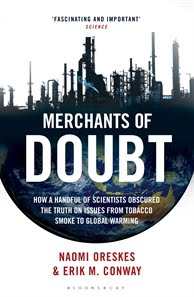
1) Merchants of Doubt by Naomi Oreskes and Eric Conway


The troubling story of how a cadre of influential scientists have clouded public understanding of scientific facts to advance a political and economic agenda.


2) Climate Change Denial by Hayden Washington and John Cook


Shows how we can break through denial, accept reality, and thus solve the climate crisis. The authors examine the nature of climate change denial, its history, how we let denial prosper, and how we can roll back denial.


3) Hidden Reality by Brian Greene


Explores our most current understanding of the universe, its deepest laws of nature, and our continuing quest to know more. The Hidden Reality reveals how major developments in different branches of fundamental theoretical physics - relativistic, quantum, cosmological, unified, computational - have all led us to consider one or another variety of parallel universe.


4) The Business of Nature: John Gould and Australia by Roslyn Russell


A tale of enduring love and of a man’s unending ability to see beauty in nature, despite the greatest of life’s tragedies.


5) The Beginning of Infinity by David Deutsch


In this important new book David Deutsch, argues that explanations have a fundamental place in the universe. They have unlimited scope and power to cause change, and the quest to improve them is the basic regulating principle not only of science but of all successful human endeavor.

Friday, 3 June 2011

Don't Leave Childhood Without This!


Don't Leave Childhood Without… came about when a group of experienced children's booksellers based in Sydney (The Specialist Children's Booksellers) decided that there was a need for a small and inexpensive guide to the books that we thought were essential reading for youngsters. When we added up our combined time in the book trade, we came up with the impressive figure of 300+ years, so putting aside dodgy maths, we thought we were entitled to say we were experts!


The first edition came out in 2002, after many late nights, occasionally heated (but mostly good-natured) discussions over what constituted indispensible reading matter, and an awful lot of unforeseen details that needed clarifying. When we had sold - much to our delighted surprise - most of the first print run by the first year and a half, we decided to update and reprint. More late nights, heated discussions and unforeseen details to clarify, we printed 10 000 copies of the second edition in 2004, and this time were in a position to make a profit, which we decided to funnel towards the Indigenous Literacy Foundation.


Our little guide has continued to sell steadily, and raise a nice amount for the cause of advancing literacy in underprivileged areas, and we have been very proud of it. But even 10 000 copies run out eventually, so the group decided to embark on the third edition. After (yep, you guessed it) more late nights, warm discussions and the inevitable small details that always crop up, but this time with the help of the indefatigible Simon Milne of Leading Edge Books (a buying group set up to assist independent bookshops) the third edition arrived last month. The art design has been tweaked, but the guiding principles remain the same: all children should have access to quality books. And yes, all profits still go to the Indigenous Literacy Foundation, so you help the children you know by using it, and children you don't, by buying it! Lindy